
Why a New HVAC System Can Still Feel Humid
Many homeowners assume that installing a brand-new HVAC system will automatically fix humidity problems. So when the house still feels sticky, clammy, or uncomfortable, the equipment often gets blamed.
In reality, most humidity problems are not caused by bad equipment — they’re caused by how the system was designed and installed.
Especially in coastal North Carolina, humidity control depends on more than just the size of the air conditioner.
Why humidity is a design problem, not an equipment problem
Air conditioners remove humidity as a byproduct of cooling, but only when certain conditions are met:
- The system must run long enough
- Airflow must be within a narrow target range
- The home’s duct system must be tight and balanced
- The system must be properly sized for the home
When any of these are wrong, the system cools the air quickly but does not run long enough to remove moisture.
The result:
- Cool air
- High humidity
- Discomfort
The most common reasons new systems fail to control humidity
1. The system is oversized
This is the most common issue we see.
Oversized systems:
- Cool the house too fast
- Shut off before removing enough moisture
- Short-cycle all day
Bigger is not better — especially in humid climates.
2. No Manual J load calculation was performed
Many systems are still sized using rules of thumb or the size of the old unit.
That approach ignores:
- Insulation levels
- Window types
- Air leakage
- Duct losses
- Actual heat and moisture load
Without a Manual J load calculation, there’s no way to know what the house actually needs. Manual J is the industry standard for residential load calculations, developed by the Air Conditioning Contractors of America (ACCA) to properly size HVAC systems based on the home — not guesswork.
3. Duct leakage pulls humid air into the home
Leaky ductwork can:
- Pull hot, humid attic or crawlspace air into the system
- Increase moisture load dramatically
- Overwhelm even brand-new equipment
This is extremely common in coastal homes.
4. Incorrect airflow across the coil
Humidity removal happens at the evaporator coil.
If airflow is:
- Too high → moisture passes right through
- Too low → coil freezes and performance drops
Airflow must be measured, not guessed.
5. Ventilation and pressure issues
Homes that are:
- Too tight
- Or improperly ventilated
Can trap moisture or pull in humid outdoor air through gaps and cracks.
Humidity problems are often pressure problems in disguise.
Why changing equipment alone often doesn’t work
Replacing equipment without testing is like replacing a car engine without checking the fuel system.
If the underlying issues remain:
- Duct leakage
- Oversizing
- Airflow imbalance
- Pressure problems
The new system will behave exactly like the old one.
How we diagnose humidity problems differently
Instead of guessing, we test.
Our diagnostic process can include:
- Manual J load calculations
- Duct leakage testing
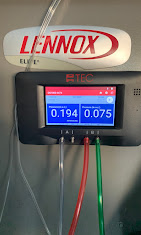
- Airflow measurement
- Static pressure testing
- System runtime evaluation
This allows us to identify why humidity is high — not just treat the symptoms.
What a real solution looks like
Fixing humidity properly may involve:
- Correctly sizing equipment
- Adjusting airflow
- Sealing ductwork
- Improving ventilation strategy
- Addressing building envelope issues
The solution depends on the house — not a one-size-fits-all answer.
The bottom line
If your home still feels humid after installing a new HVAC system, the problem is almost never the brand of equipment.
It’s the design, airflow, or duct system.
Humidity control starts with proper diagnostics.
Need help with humidity or comfort issues?
If your home feels uncomfortable, sticky, or inconsistent — even with a newer system — we can help identify the real cause.
Schedule a diagnostic visit and we’ll evaluate your system using measured data, not guesswork.
👉 [Request Service]